Phone: +86 13570669003
  Email: sales@bocon-tec.com


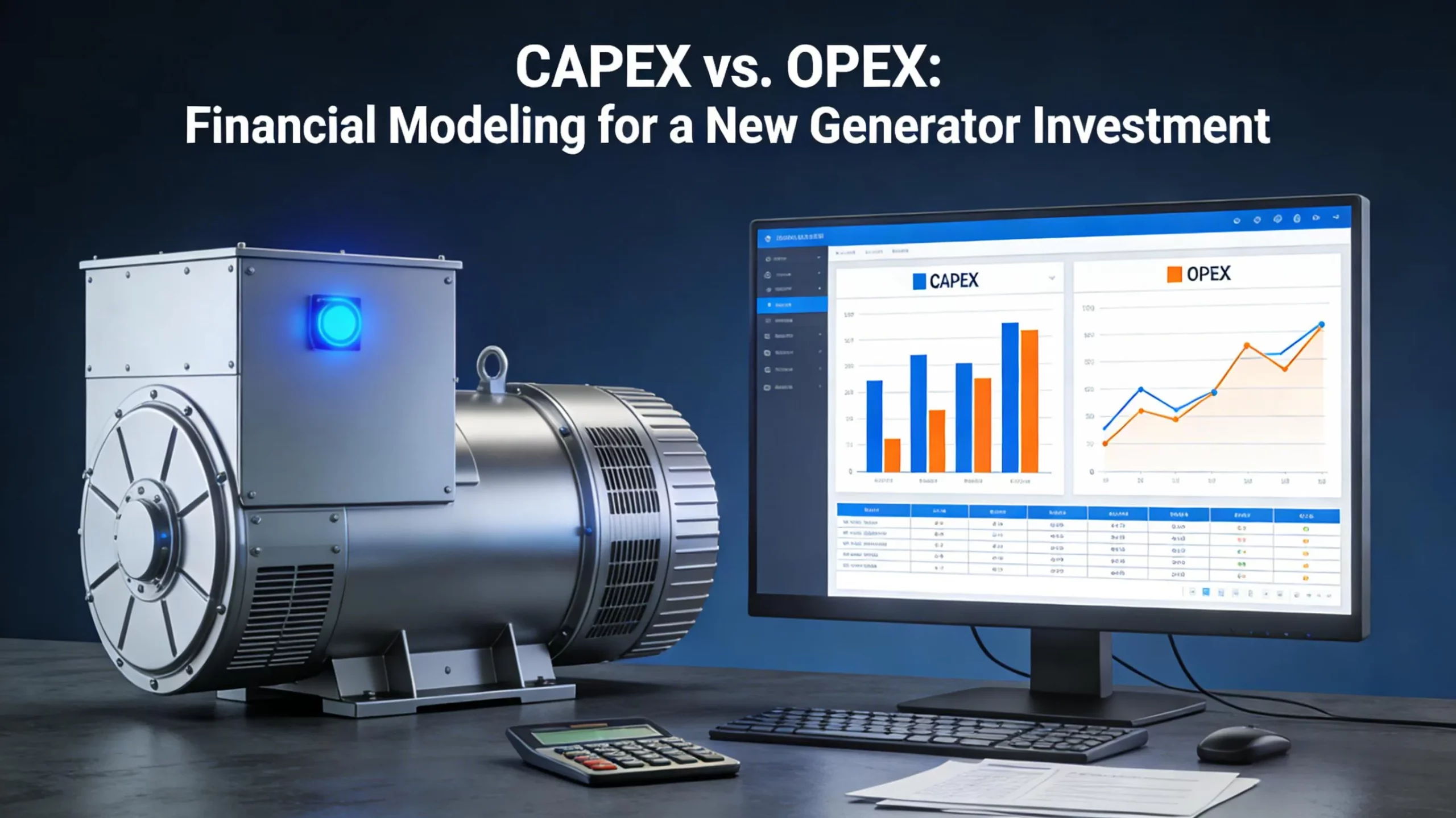
CAPEX vs. OPEX: Financial Modeling for a New Generator Investment
Making the Business Case with Numbers
Securing budget approval for a major capital item like a diesel generator set requires a solid financial model. Simply comparing purchase prices is misleading. A true Economics & Value analysis requires modeling all Capital Expenditures (CAPEX) and Operating Expenditures (OPEX) over the asset's lifecycle. Here’s a framework to build your case.
1. Capital Expenditures (CAPEX) - The Upfront Costs
- Generator Unit Cost: Base price of the silent or open frame set.
- Ancillary Equipment: Automatic Transfer Switch (ATS), cabling, exhaust system, base fuel tank, acoustic enclosure (if not included).
- Installation & Civil Works: Foundation, canopy housing, electrical connection labor.
- Initial Spare Parts Kit.
- Import Duties & Taxes (if applicable).
- Financing Costs: Interest if the purchase is financed via a loan.
2. Operating Expenditures (OPEX) - The Recurring Costs
These are often underestimated but dominate the total cost of ownership.
- Fuel: The largest OPEX. Calculate: (Annual Running Hours) x (Fuel Consumption at Average Load in L/hr) x (Diesel Price per Liter).
- Preventive Maintenance: Scheduled oil, filter, coolant changes. Factor in labor and parts.
- Corrective Maintenance & Repairs: Budget for unscheduled repairs (typically 2-5% of CAPEX per year after warranty).
- Labor: Cost of in-house staff or contracted service technicians for monitoring and upkeep.
- Insurance.
- Depreciation: A non-cash accounting expense that affects the balance sheet.
Building the 10-Year Financial Model
Create a spreadsheet projecting costs over a typical 10-year lifecycle.
| Year | CAPEX | OPEX (Fuel+Maint) | Cumulative Cost | Value of Downtime Avoided* |
|---|---|---|---|---|
| 1 | $XX,XXX | $X,XXX | $XX,XXX | $Y,YYY |
| 10-Year Total | $XX,XXX | $XXX,XXX | $XXX,XXX | $YYY,YYY |
*This is the crucial "benefit" side of the equation. Estimate the cost of a single hour of production/operation loss. Multiply by the expected number of grid outages the generator will prevent.
The Bottom Line: Use this model to compare the Net Present Value (NPV) of purchasing versus long-term rental. You'll often find that for any application with regular use, ownership (despite high CAPEX) offers a lower total lifecycle cost and a clear, positive ROI when the value of avoided downtime is factored in.